
What Is FSI in Real Estate? Understanding Floor Space Index (FSI Full Form & Importance)
M2W Realty on 15 Oct, 25
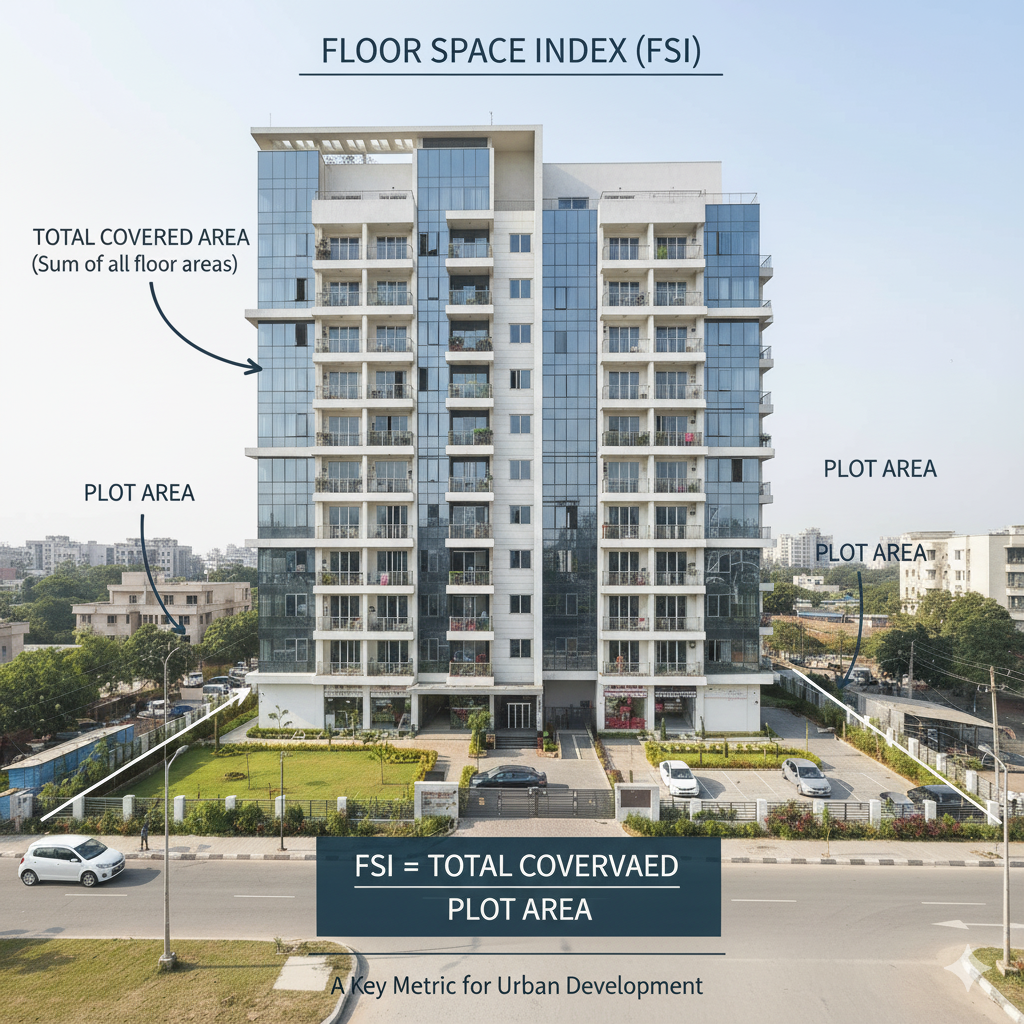
As you read listings, developer brochures or city planning guidelines, you will regularly encounter the term FSI. However, what is it and why do you care as a homebuyer, investor or developer? This paper is a deep discussion of the concept of FSI (Floor Space Index), its full description and calculation, why the concept is important in real estate development, factors and differences by city in India and presents the practical advice on the use of FSI knowledge to make quality decisions on property.
By the end, you'll understand why FSI is a critical metric, and how you can leverage that understanding while exploring properties with M2W Realty (and possibly booking a site visit to see the difference in real life).
What Does FSI Mean (Full Form)?
FSI is the abbreviation for Floor Space Index (also commonly referred to as FAR, or Floor Area Ratio, in some jurisdictions). It is a numerical ratio that measures how much built-up floor area (across all storeys) you can legally construct on a given plot of land. In simple terms, it tells you the "allowable vertical potential" of that plot. For example, in Indian urban planning parlance, an FSI of 2.0 on a land parcel of 1,000 square metres means you can build up to 2,000 square metres of total floor area across floors.
Although FSI and FAR are used interchangeably in many instances, the difference is more of expression. FSI is often put in the form of a ratio (e.g., 1.5), though FAR is sometimes in the form of percentage or some percentage or decimal. The maximum FSI in various zones is determined by the city development plans and regulatory standards which are established by the local municipal authorities or urban development bodies.
Since FSI is the direct limit on the amount of building per acre, it becomes a base value to the architects, developers, and purchasers alike, defining the design, building density, and economics of land use.
How to Calculate FSI? (Formula & Example)
The formula for FSI is straightforward:
FSI = (Total Built-up Area of All Floors) ÷ (Plot Area)
Here, "Total Built-up Area" includes the sum of floor areas across all permitted levels (basements, mezzanines, ground, upper floors) that are counted under FSI by the municipal norms. "Plot Area" is the gross area of land on which the building is proposed.
Let's look at an example for clarity:
- Suppose you own a plot of 1,200 sq m.
- The permissible FSI is 1.8.
- Then total built-up permitted = 1.8 × 1,200 = 2,160 sq m. If you decided to build 4 floors, you might allocate ~540 sq m per floor (so long as design, setbacks, and structural norms allow).
You must also keep in mind that not every portion of a building may count toward FSI. Common areas (like staircases, lifts, lobbies), parking, utility shafts, and open terraces may or may not be included depending on local rules.
Thus, while the arithmetic is simple, the practical application demands careful attention to jurisdictional guidelines.
Why Is FSI Important in Real Estate?
FSI is not just a technical metric, it influences nearly every dimension of real estate design, valuation, regulation, and sustainability. Below are some key reasons why FSI is central in real estate decisions:
- 1. Optimizing Land Use & Maximizing Returns
An increased FSI will allow developers to place greater built-up space on a fixed piece of land, allowing more units or larger spaces, resulting in better cost efficiencies and revenue potential. Indicatively, a city lot in a prime location would have a greater value in a per-squares foot due to the fact that more vertical development can be done. - 2. Influencing Real Estate Valuation
FSI becomes a crucial factor in land pricing since it influences a plot's "development potential." In order to anchor the land premium, buyers frequently calculate how many square feet they can extract (legally) via FSI. - 3. Regulating City Density & Infrastructure Stress
Uncontrolled construction density can strain transport, water, sewage, green spaces, and social amenities. By imposing FSI limits, city planners ensure balanced growth, prevent overcrowding, and coordinate infrastructure provisioning. - 4. Shaping the Skyline & Urban Character
Building height and bulk are indirectly determined by FSI. A zone with a low FSI will have buildings that are shorter and more dispersed; a zone with a high FSI will encourage vertical growth. Light, ventilation, aesthetics, and environmental comfort all depend on this balance. - 5. Encouraging Redevelopment & Efficient Land Use
In mature cities where horizontal expansion is limited, upward redevelopment becomes necessary. Higher permissible FSI, or additional "premium FSI" mechanisms (which allow "extra" FSI at a cost or incentive), can catalyze redevelopment of obsolete structures. - 6. Mitigating Legal & Compliance Risk
Constructing beyond the sanctioned FSI exposes developers to legal penalties, demolition notices, or forced modifications. Hence, adherence to FSI norms is imperative for risk mitigation.
Hence, FSI acts as the linchpin connecting urban design, economic viability, regulatory safety, and sustainable growth.
Factors That Influence Permissible FSI
The maximum FSI allowed on any plot is not uniform. It varies by locality, regulations, and multiple factors. Some of the common determinants include:
- Zoning & Land-Use Regulation
Residential, commercial, industrial, mixed-use -- different zones carry different FSI ceilings set by municipal bodies. - Road Width & Access
Plots along wide roads or major corridors often attract higher FSI because connectivity and infrastructure support higher density. - Plot Size / Shape
Smaller or irregular plots may get lower FSI to ensure safe design, setbacks, ventilation, and structural feasibility. Larger plots may have more flexibility. - Infrastructure Readiness
Whether the area has adequate water supply, sewage, power, roads, storm drainage, etc., influences how much permissible load (i.e., FSI) can be supported. - Special Development Schemes / Incentives
Some government or city renewal schemes offer bonus or premium FSI in exchange for public amenities, green commitment, affordable housing, heritage conservation, etc. - Environmental Constraints
Areas near water bodies, hills, protected zones, or ecological sensitive zones may have stricter FSI ceiling. - Historical / Heritage Protections
If a plot lies in heritage precincts, FSI may be constrained to preserve visual harmony or historical character. - Local Authority / Municipal Plans
5-year or 20-year master plans by city development authorities may revise FSI norms going forward.
Because of these variables, one neighborhood in a city may permit FSI of 1.33 while another allows 3.0 or more, depending on infrastructure, zoning, location premium, and policy incentives.
FSI Norms & Examples in Indian Cities
To better ground theory, here are some illustrative examples of FSI norms (or variations) in Indian cities:
- In Mumbai, for typical residential zones, the permissible FSI is often around 1.33 for many areas.
- However, in premium or redevelopment corridors like Bandra-Kurla Complex (BKC), the FSI may be substantially higher (e.g. 5.0 or more) to reflect infrastructure support and commercial densities.
- In Delhi, FSI/FAR norms vary from around 1.2 to 3.5 in various zones per the Master Plan, and redevelopment projects might enjoy bonus FSI.
- In developing cities, FSI may be more generous in central zones but lower in peripheral or newly developing localities where infrastructure is constrained.
One recent statistic: in Mumbai's redevelopment sector, over 44,000 new apartments are projected to be created by 2030, largely leveraging FSI adjustments and redevelopment schemes across society plots. This reveals how central FSI is in shaping city growth trajectories.
How Buyers & Investors Should Use FSI Knowledge?
- 1. Calculate Potential Yield Before Purchase
Ask the developer or look up the approved FSI in the local records when assessing a plot or apartment that is still under construction. Determine the per-square-foot cost, including land and building, by calculating the maximum amount of built-up that is feasible. This provides a more grounded perspective on value. - 2. Scrutinize Premium / Bonus FSI Clauses
Developers frequently pay a premium to the municipal authority or meet requirements in order to receive additional FSI, also known as "premium FSI." As a purchaser, ascertain whether this has been approved and included in the cost. - 3. Watch Out for Unauthorized Construction
Some projects covertly exceed approved FSI and later face legal issues, penalties, or forced modifications. Confirm approvals from municipal bodies and check that built-up area claimed in marketing matches sanctioned FSI. - 4. Negotiate Better with Clarity
A buyer armed with awareness of FSI can negotiate more effectively (e.g. on cost of extra FSI, amenities, or premium charge). Developers know that land with higher FSI is more valuable, so you should too. - 5. Check Future Zoning Changes
Municipal authorities sometimes revise master plans and relax FSI norms in select corridors. If a property lies along growth axes (metro lines, express corridors), it may gain value via future FSI upgrades. - 6. Compare Across Localities
Two plots of the same size may have different FSI limits due to location, road access, and infrastructure. Always compare effective buildable potential, not just plot size. - 7. Consult Experts / Architects
Since built-up area counting, exemptions, definitions (what counts in FSI vs what doesn't) vary by municipality, don't rely solely on marketing claims. Engage architects or property consultants to validate claims.
Common Misconceptions & FAQs Surrounding FSI
- "FSI includes everything built": Not always. Some components like open verandas, external balconies, parking, utility shafts, or common corridors may be excluded per local rules.
- "Higher FSI is always better": Not necessarily. Too high densities may reduce livability, create congestion, or overburden infrastructure. A balanced FSI ensures comfort and sustainability.
- "You can always demand that the developer give you unclaimed FSI": Only if legally sanctioned. Developers often have to pay for premium FSI. Unapproved claims can lead to legal trouble.
- "FSI is permanent and fixed forever": No, municipal bodies may revise FSI norms over time as infrastructure improves or as part of city planning.
- "FSI refers to built-up area only on the ground floor": Incorrect, FSI covers cumulative area across all counted floors (unless restricted) via the formula.
Conclusion
At M2W Realty, we combine deep domain expertise, transparent property disclosures, and on-ground support to help you make confident decisions. If you're evaluating plots, flats, or investment properties, don't just rely on glossy brochures, see the space for yourself. We warmly invite you to book a site visit with M2W Realty, explore our curated projects, inspect layouts, check infrastructure, and validate FSI-sanctioned prospects in person. Let us help you find the right property with clarity and conviction.